Although it's been a while since I've posted anything new, I assure you I have been hard at work. I will have posts on two projects in the next weeks, documenting historic streetcar development and Portland bicycle history, respectively.
In the meantime, I was hard at work applying the finishing touches to an article on the Crooked River in Central Oregon that I have submitted to the Oregon Historical Quarterly. Its not transportation related, so I'll spare you the details (hopefully, you can read it in about six months - give or take - in the OHQ).
Here is a little sneak peak of the streetcar post. (pdf)
And here is one on Portland Bike history. (pdf)
Showing posts with label streetcars. Show all posts
Showing posts with label streetcars. Show all posts


More on Historic Streetcar (continued)

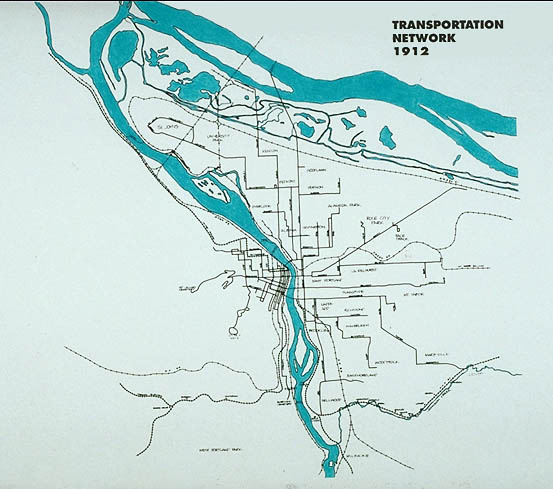
First off, thanks to all of you who commented or emailed me with ideas on where to track down the historic streetcar maps. The maps from the City of Portland site, which includes the 1890 streetcar network and several other snapshots, can be found at the Oregon Historical Society. If you do a search under "Transportation Network 1890" you can find them easily. They are actually hand drawn maps, done in 1973, by a city employee and they are quite large. In conjunction with Richard Thompson's fantastic website, we've been able to start overlaying the streetcar lines onto a current Portland map.
OHS has other good maps, but they are essentially not duplicable. So be prepared to bring some paper and sketch away (its what I did).
The image in the top right corner is just our first attempt to digitize the streetcar network in 1890. Click it to see a larger image. I'll keep you posted...
More on Historic Streetcar
I am working on a project right now with a fellow PSU student, Ben Kinkley, to overlay the historic streetcar lines on a current map of Portland. The idea is to determine how the streetcar system impacted Portland's development, particularly urban density.
I am really interested in looking at the Springwater corridor (probably because its one of the few places I know where we've had a streetcar line). Did population density change when the line stopped operating? Has the trail changed residential patterns? How about the widening of Johnson Creek Boulevard?
I plan to post our findings here, or perhaps on a mutual site created by Ben and I.
To all you readers out there, I ask: Anyone know where the historic streetcar maps of Portland might live? The City Archives, you say? Nope. Oregon Historical Society? Maybe, I'll find out today. Chime in if you've got any ideas...
I am really interested in looking at the Springwater corridor (probably because its one of the few places I know where we've had a streetcar line). Did population density change when the line stopped operating? Has the trail changed residential patterns? How about the widening of Johnson Creek Boulevard?
I plan to post our findings here, or perhaps on a mutual site created by Ben and I.
To all you readers out there, I ask: Anyone know where the historic streetcar maps of Portland might live? The City Archives, you say? Nope. Oregon Historical Society? Maybe, I'll find out today. Chime in if you've got any ideas...
Streetcar Ghosts
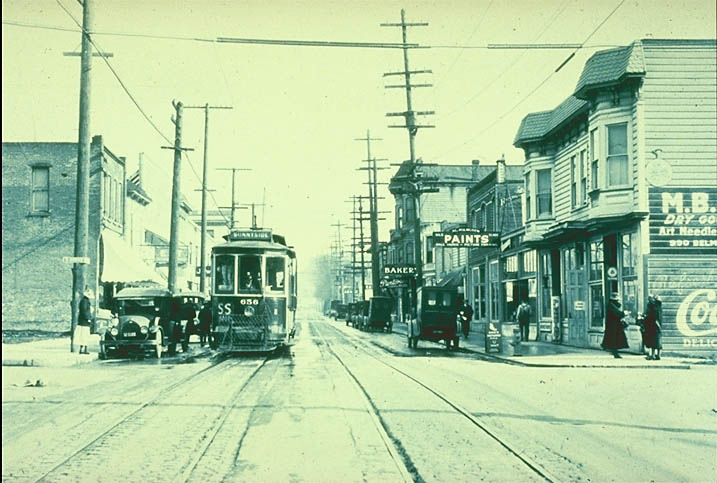
Yes, Portland once sported one of the most substantial streetcar networks west of the Mississippi. The Willamette Valley had electric rail from Oregon City to Vancouver in the early
 1900s. Our current 18-mile long Springwater Trail is a former rail line. The Kenton neighborhood in North Portland, built by the Swift Meatpacking Company, was anchored by a streetcar line along Denver Avenue.
The blog Cafe Unknown has a great post on remnants of Portland's streetcar system here and a post about the city's fleeting experiment with electric buses in the 1940s.

Martha Bianco's dissertation, Private profit versus public service : competing demands in urban transportation history and policy, Portland, Oregon, 1872-1970, takes a comprehensive look at Portland's streetcar system and other aspects of urban transporation from a public policy perspective. It is available at PSU's library. She has also published several articles including, “The Decline of Transit—Corporate Conspiracy or Failure of Public Policy?: The Case of Portland, Oregon,” Journal of Policy History, Vol. 9, No. 4, Winter 1997: 450-474.
 1900s. Our current 18-mile long Springwater Trail is a former rail line. The Kenton neighborhood in North Portland, built by the Swift Meatpacking Company, was anchored by a streetcar line along Denver Avenue.
The blog Cafe Unknown has a great post on remnants of Portland's streetcar system here and a post about the city's fleeting experiment with electric buses in the 1940s.

Martha Bianco's dissertation, Private profit versus public service : competing demands in urban transportation history and policy, Portland, Oregon, 1872-1970, takes a comprehensive look at Portland's streetcar system and other aspects of urban transporation from a public policy perspective. It is available at PSU's library. She has also published several articles including, “The Decline of Transit—Corporate Conspiracy or Failure of Public Policy?: The Case of Portland, Oregon,” Journal of Policy History, Vol. 9, No. 4, Winter 1997: 450-474.
Conspiracy and Transit
Anyone who has even a fleeting interest in transportation has undoubtedly heard the story of how General Motors, Standard Oil, and Firestone conspired to buy up streetcar and other electric urban rail systems in order to supplant them with buses. But do we really have GM, et. al. to blame for our abandonment of streetcars and our adoption of the internal combustion engine for all things transport? Martha Bianco, PSU professor in the School of Urban Studies and Planning, has this to say:
If you are still not convinced of GM's innocence, check out Cliff Slater's article. Slater, who is not an academic but has an interest in the economic history of public transport in the U.S., has this to say:
The failure of public policy should be assigned as much blame if not more than the machinations of the diesel-bus industry for the substitution of inferior motor buses. It was, after all, the regulatory agencies modernization requirements that contributed to transit companies unmanageable debt load and inability to adapt in a constrained purchasing environment. It was also franchise requirements for service expansion that prompted widespread installation of buses in the first place and that made their continued purchase economical to transit companies in light of their other debts and obligations. Modernization requirements were in many cases the straw that broke the camel's back, forcing transit companies to provide service improvements and extensions that were economically so prohibitive that the companies had no choice but to implement full-scale motorization.Check out the rest of Bianco's article here.
Public policy also encouraged expansion of the automobile industry. The highway planning of this period is the prime example of how public policy continued to accommodate and facilitate the automobile. As far as mass transit was concerned, there was wide consensus that motor buses could easily operate on the great new superhighways; electric streetcars and trolleys could not.
If you are still not convinced of GM's innocence, check out Cliff Slater's article. Slater, who is not an academic but has an interest in the economic history of public transport in the U.S., has this to say:
The issue is whether or not the buses that replaced the electric streetcars were economically superior. Without GM's interference would the United States today have a viable streetcar system? This article makes the case that, GM or not, under a less onerous regulatory environment, buses would have replaced streetcars even earlier than they actually did.Check out the rest of Slater's article here.
Subscribe to:
Posts (Atom)

