Showing posts with label Portland history. Show all posts

More on Historic Streetcar (continued)


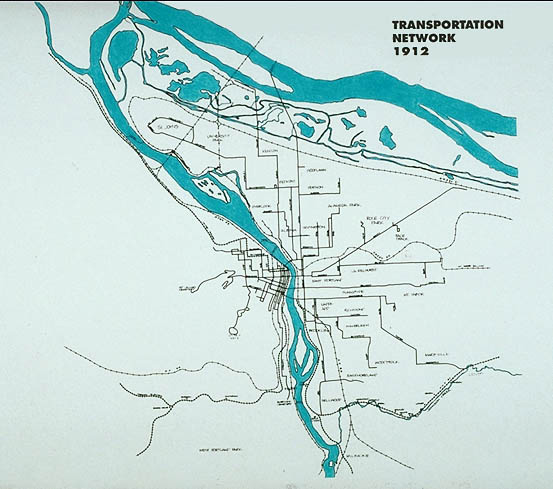
First off, thanks to all of you who commented or emailed me with ideas on where to track down the historic streetcar maps. The maps from the City of Portland site, which includes the 1890 streetcar network and several other snapshots, can be found at the Oregon Historical Society. If you do a search under "Transportation Network 1890" you can find them easily. They are actually hand drawn maps, done in 1973, by a city employee and they are quite large. In conjunction with Richard Thompson's fantastic website, we've been able to start overlaying the streetcar lines onto a current Portland map.

OHS has other good maps, but they are essentially not duplicable. So be prepared to bring some paper and sketch away (its what I did).

The image in the top right corner is just our first attempt to digitize the streetcar network in 1890. Click it to see a larger image. I'll keep you posted...

More on Historic Streetcar

I am working on a project right now with a fellow PSU student, Ben Kinkley, to overlay the historic streetcar lines on a current map of Portland. The idea is to determine how the streetcar system impacted Portland's development, particularly urban density.

I am really interested in looking at the Springwater corridor (probably because its one of the few places I know where we've had a streetcar line). Did population density change when the line stopped operating? Has the trail changed residential patterns? How about the widening of Johnson Creek Boulevard?

I plan to post our findings here, or perhaps on a mutual site created by Ben and I.

To all you readers out there, I ask: Anyone know where the historic streetcar maps of Portland might live? The City Archives, you say? Nope. Oregon Historical Society? Maybe, I'll find out today. Chime in if you've got any ideas...

Interstate 5

While Oregon lore is full of stories about the defeat of the Mt. Hood Freeway, you don't hear quite as much about the building of Interstate 5. And with the Interstate Bridge taking center stage in the news lately, now is a good time to think about the entire I-5 corridor and how it has impacted Portland and its neighborhoods.

Following the same pattern of development as many other U.S. cities, the interstate in Portland cut through a predominantly African-American neighborhood, essentially bisecting the community and dislocating many residents. While this was the mold used in U.S. cities, other countries did not run their major freeways through densely populated areas. For example, in the March 2001 Journal of Urban History, in an article titled "The History of American Cities and Suburbs," Lionel Frost writes,
In the 1950s, when American cities were building freeways lavishly, Toronto built a subway system. The freeways that were built there stopped short of entering the inner neighborhoods. There are several reasons why these cities developed as they did: they did not have access to federal funding for freeway building; in Australia, gasoline taxes are much higher. A more fundamental explanation for this distinctiveness lies in the choices that cities made at crucial stages in their histories, which took them along different paths and created conditions that shaped future decision making.
Did American cities have the same discretion that these Canadian and Austrailian cities had in federal transportation planning? From my understanding, the first American city to fight against a federal project was Boston in the late 1960s, where city officials and citizens oppossed the Inner Belt expansion project. Was it the experience of the earlier built interstates that gave the people of Boston (and later Portland, with the Mt. Hood Freeway) the ability to fight against new freeway projects? Did anyone fight against I-5's construction here in Portland?

Regarless of who ultimately controlled the decision making process, I am interested in the main actors here in Portland and on the state and federal levels that made I-5 a reality. How did the decision making take place? Who was included in that process? Were there any local, state, or federal politicians involved, or was this simply a project designed by engineers that met no resistance from elected officials?

Early Portland Bicycle History

A lot of us know a thing or two about Portland's more recent bike history, from the passing of the Bike Bill in 1971 to our current push for Platinum status. But what about those early years, from the 1880s to the 1920s? The bicycle was still a fairly new, innovative transportation tool and judging from maps like this one, Portland had a thriving Wheelmen Club and Good Roads Movement.

The Oregon Historical Society has a manuscript collection documenting Oregon transportation history, including bicycles, from 1850 - 2000. I haven't gone to check this collection out, but I plan to. There is also a file on Fred T. Merrill, an early bicycle advocate who owned bike shops and opened a race track here in Portland. There are also maps from the 1970s and some older photographs, but not too much else (judging from the library catalog search I conducted; but the librarians will be much more helpful) that is cataloged specifically with the keyword or subject "bicycle." We'll have to dig a little deeper...

I recently received a phone call from a Portlander who was related to Robert McDonald Tate. While that might not be a household name, at the turn of the century Tate ran a bicycle shop in downtown Portland. While he purportedly invented the kickstand, another inventor beat him to the patent office. However, Tate did earn a patent for a new device that attached the handlebars to the frame. His invention made its way into Scientific American. These are the stories I want to hear about.

This might be an interesting read: The First Ten Years: A History of the Portland Wheelmen Touring Club, by Joe H. Heidel. It is also part of the OHS collection. People write the greatest books! Hey, we've got a book about Portland's bridges, why can't we have one about our bike clubs? From what research I've done, cyclists were a colorful bunch in those early years (and many keep that colorful tradition alive today), and deserving our attention.

Streetcar Ghosts

Yes, Portland once sported one of the most substantial streetcar networks west of the Mississippi. The Willamette Valley had electric rail from Oregon City to Vancouver in the early
1900s. Our current 18-mile long Springwater Trail is a former rail line. The Kenton neighborhood in North Portland, built by the Swift Meatpacking Company, was anchored by a streetcar line along Denver Avenue.

The blog Cafe Unknown has a great post on remnants of Portland's streetcar system here and a post about the city's fleeting experiment with electric buses in the 1940s.


Martha Bianco's dissertation, Private profit versus public service : competing demands in urban transportation history and policy, Portland, Oregon, 1872-1970, takes a comprehensive look at Portland's streetcar system and other aspects of urban transporation from a public policy perspective. It is available at PSU's library. She has also published several articles including, “The Decline of Transit—Corporate Conspiracy or Failure of Public Policy?: The Case of Portland, Oregon,” Journal of Policy History, Vol. 9, No. 4, Winter 1997: 450-474.

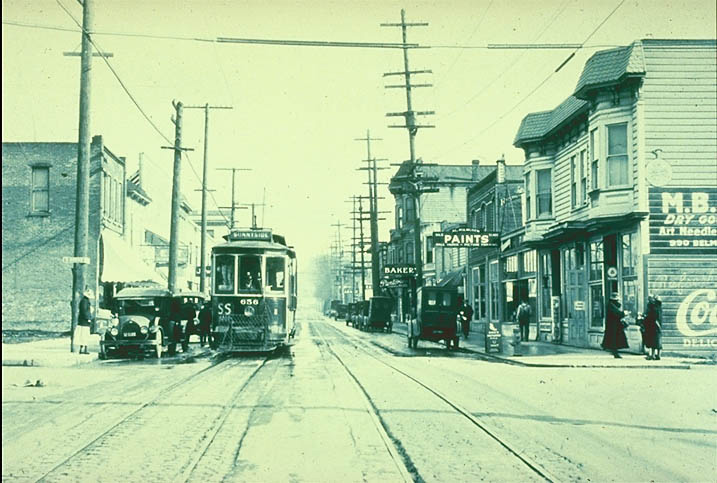
Belmont Street at 33rd Avenue, circa 1915

All of these images and more can be accessed here.

PDX Transportation History on the web

There are many others that have looked (or are looking) at aspects of Portland's transportation history. In particular, Steve Reed Johnson of Portland State University has documented and graciously made public his work on Portland's civic life, including histories of the bicycle movement and the Mt. Hood Freeway. Johnson focuses on civic life, but his work on these important aspects of Portland's transportation development are valuable additions to creating a comprehensive history.

In addition, filmmaker Clarence Eckerson Jr., who works with New York City Streets Renaissance, has many films about Portland's alternative transportation community, including vignettes from his tv show, bikeTV, and a movie that envisions what the Brooklyn-Queen Expressway could have been if New Yorkers had followed Portland's example on the Mt. Hood Freeway.

Please, let me know what I am missing. I am sure there is quite a bit more out there...